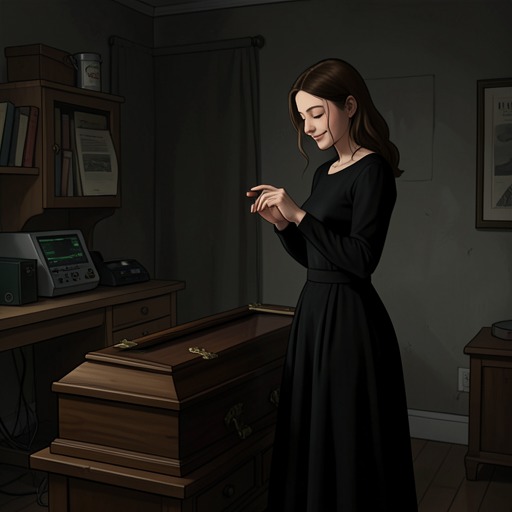
Deborah Hartzfeld's laptop
Mr. MercedesDeborah Hartsfield’s laptop is both an intimate household archive and a reluctant gateway to the hidden machinery of Brady Hartsfield’s life. At first it offers only a locked screen; once Holly Gibney finds the password in a family photograph, its carefully kept records expose the closeness and unease of Deborah’s attention to her son, and a buried file supplies the clue that redirects the investigation toward his basement computer system.
Discovery and the Locked Screen
Holly proposes bringing the laptop after the group has left the Hartsfield home. She has a practical reason: Deborah may have written down the keyboard prompts or voice-access password needed to enter Brady’s computers. K. William Hodges doubts that a mentally ill person who goes to great lengths to conceal his condition would leave such instructions where anyone could find them. Holly answers from her own experience that she knows why someone might hide such things.
At Hodges’s house on Harper Road, Holly carries the late Deborah’s laptop into the kitchen and powers it up. The Mac presents a password screen, dashing the group’s hope that it might open immediately. Jerome Robinson suggests trying Deborah’s name; when that fails, he proposes trying the two spellings of Debbie. Holly turns the task into a demand for privacy: she tells Jerome not to look over her shoulder, asks whether she can smoke, and uses a saucer for her cigarette. The computer remains closed while the hours pass. Later, it is still showing the stubborn password screen, surrounded by the dismantled contents of Deborah’s wallet, as Holly sits tired and dispirited at the table.
The Photograph That Opens It
The breakthrough comes not from a written password but from a photograph found among the items from Deborah’s wallet. On its reverse, a careful inscription identifies the picture as Mom and Her Honeyboy, taken at Sand Point Beach in August 2007. Hodges recognizes that “Honeyboy” may work as a password and slides the photograph, face down, across to Holly. She types the word and gets into the laptop.
The small gesture changes the computer from an obstacle into a source of evidence. Its access depends on the family language preserved on an ordinary photograph: a private pet name, recorded on the back of a picture, unlocks the machine. The password also directs attention toward the bond between mother and son, which proves central to what Holly finds inside.
Deborah’s Archive of Her Son
The desktop initially appears domestic and unremarkable. It holds an address book, folders for favorite recipes and saved emails, online receipts suggesting that Deborah paid most of her bills online, and an album containing photographs of Brady at different ages. Her iTunes library includes television shows and a single music album, Alvin and the Chipmunks Celebrate Christmas. The laptop presents a life organized through familiar household categories, not an overt record of wrongdoing.
A search for Brady produces several results, including entries in the recipe file and items tagged as Brady Favorites, but nothing immediately revealing. Jerome suggests searching for HONEYBOY instead. That search finds a document buried deep in the hard drive, and its contents make Deborah’s attention to her adult son strikingly concrete: it records Brady’s clothing sizes, the Christmas and birthday gifts she has bought him over ten years, his Social Security number, and scanned copies of his car registration, insurance card, and birth certificate. It also lists his coworkers at Discount Electronix and Loeb’s Ice Cream Factory. Beside Shirley Orton’s name, Deborah has added the question of whether Shirley is Brady’s girlfriend.
The file is more than a collection of convenient records. It joins practical details, repeated gift-giving, and close monitoring in one private inventory. Holly reads this pattern as evidence that Deborah knew Brady was not right. The laptop cannot by itself establish all that Deborah understood, but her record-keeping makes the extent of her attention to him visible—and gives the investigators information that can be searched rather than guessed at.
The Basement Clue and Its Consequences
At the bottom of the HONEYBOY document, Holly finds a folder marked BASEMENT. Jerome opens it. Its contents are extraordinarily brief: “Control = lights” and “Chaos?? Darkness??” The laptop thus points beyond Deborah’s own files toward Brady’s basement, while the contrast between control and chaos gives the clue an unsettlingly compressed form. The words do not explain the computer system or disclose everything it contains; their importance lies in showing the investigators where to look next.
The laptop’s role is therefore a sequence of thresholds: a password screen delays access, a family photograph supplies the key, Deborah’s archive reveals the depth and texture of her record-keeping, and the buried BASEMENT folder redirects the search toward Brady’s concealed system. Its narrative importance rests on the collision between ordinary domestic information and hidden technical danger. What first looks like a private computer full of recipes, receipts, photographs, and saved messages becomes an evidentiary passage from the family archive to the machinery Brady has kept out of sight.